





Welcome back to The Defender’s Library, our ongoing series where we break down the most influential books in the world of personal protection and firearms training. In Part 1, we explored the mindset required for high-stakes environments. Today, we are diving into a book that is often cited as the definitive "math" of active shooter events: The First 30 Seconds by Ed Monk.
If you have spent any time in our classrooms at C&G Solutions, you know we don't just teach you how to shoot; we teach you how to think. Ed Monk’s work perfectly aligns with our mission because it strips away the "what ifs" and replaces them with cold, hard data. Whether you are a retired officer looking for your HR218/LEOSA Recertification or a concerned citizen finishing your NY State 18-hour Conceal Carry Course, understanding Monk’s lessons is crucial for your survival.
Ed Monk’s primary thesis is simple, yet chilling: Active killer events are governed by time and simple math.
Monk argues that an active shooter is essentially a "human efficiency" problem. Once an attacker begins, they can typically shoot multiple victims per minute. Based on decades of case studies, the data shows that if a killer is not met with effective resistance within the first 30 seconds, the event is highly likely to result in double-digit casualties.
Think about that for a moment. Thirty seconds is roughly the time it takes to realize what is happening, process the sensory input, and decide on a course of action. If you spend those 30 seconds frozen in disbelief, the "math" of the situation turns tragic.
At C&G Solutions, we emphasize that your goal as a licensed carrier isn't just to "have a gun." Your goal is to shrink the window of opportunity for the attacker. The longer an attacker operates unopposed, the higher the body count.

There is a common misconception in the firearms community that "speed" refers only to how fast you can clear your holster. While a clean, fast draw is a vital skill, Monk teaches us that decision-making speed is the true lifesaver.
In many active killer scenarios, the hero wasn't the person with the fastest split times on a range; it was the person who recognized the threat and acted immediately. This is what Monk calls "Rapid Threat Assessment."
When we train at our location at Mariners Cove, 3615 Oceanside Road, Oceanside, NY, we challenge our students to look beyond the paper target. We ask:
Monk’s research shows that events where the killer is confronted quickly, often by citizens or on-site staff using whatever they have at hand, tend to end with single-digit casualties. Defend with skill, Act with confidence.
To truly understand Monk’s lessons, we have to look through the lens of Alexis Artwohl and Loren W. Christensen’s core concepts from Deadly Force Encounters. They describe the Survival Triangle, which consists of three pillars:
Ed Monk’s "First 30 Seconds" is essentially a deep dive into the Environment and Mindset portions of that triangle. If your environment is a "soft target" (like a mall or a theater), your mindset must be geared toward immediate, aggressive counter-violence if a threat emerges. You cannot wait for the police to arrive, their response time is rarely under the critical 30-second mark.
One of the hardest parts of rapid threat assessment is overcoming the physiological hurdles your body throws at you. Artwohl and Christensen highlight several perceptual distortions that occur during high-stress encounters:
Monk’s data-driven approach helps mitigate these distortions. By having a pre-planned "if-then" mental map, you reduce the cognitive load on your brain during an emergency. Instead of trying to solve a complex puzzle while your heart is racing at 160 BPM, you are simply executing a pre-planned response.
Living and carrying in New York presents unique challenges. From the crowded streets of the city to the suburban sprawl of Long Island, the "environment" is constantly changing.
Monk is a vocal critic of "security theater", measures like cameras or buzzers that don't actually stop an attacker once they are inside. For the NYC/NYS concealed carrier, this means you are your own first responder.
When you join us for a Private Pistol Coaching session, we don't just work on your "press to the rear" (never "squeeze"!). We work on your situational awareness. We teach you to identify the "pre-attack indicators" that Monk and Artwohl describe, so you can make your assessment before the first shot is even fired.
Rapid threat assessment isn't just about stopping the threat; it's also about saving lives in the aftermath. This is the "post-incident legal and emotional survival" that Artwohl and Christensen write about.
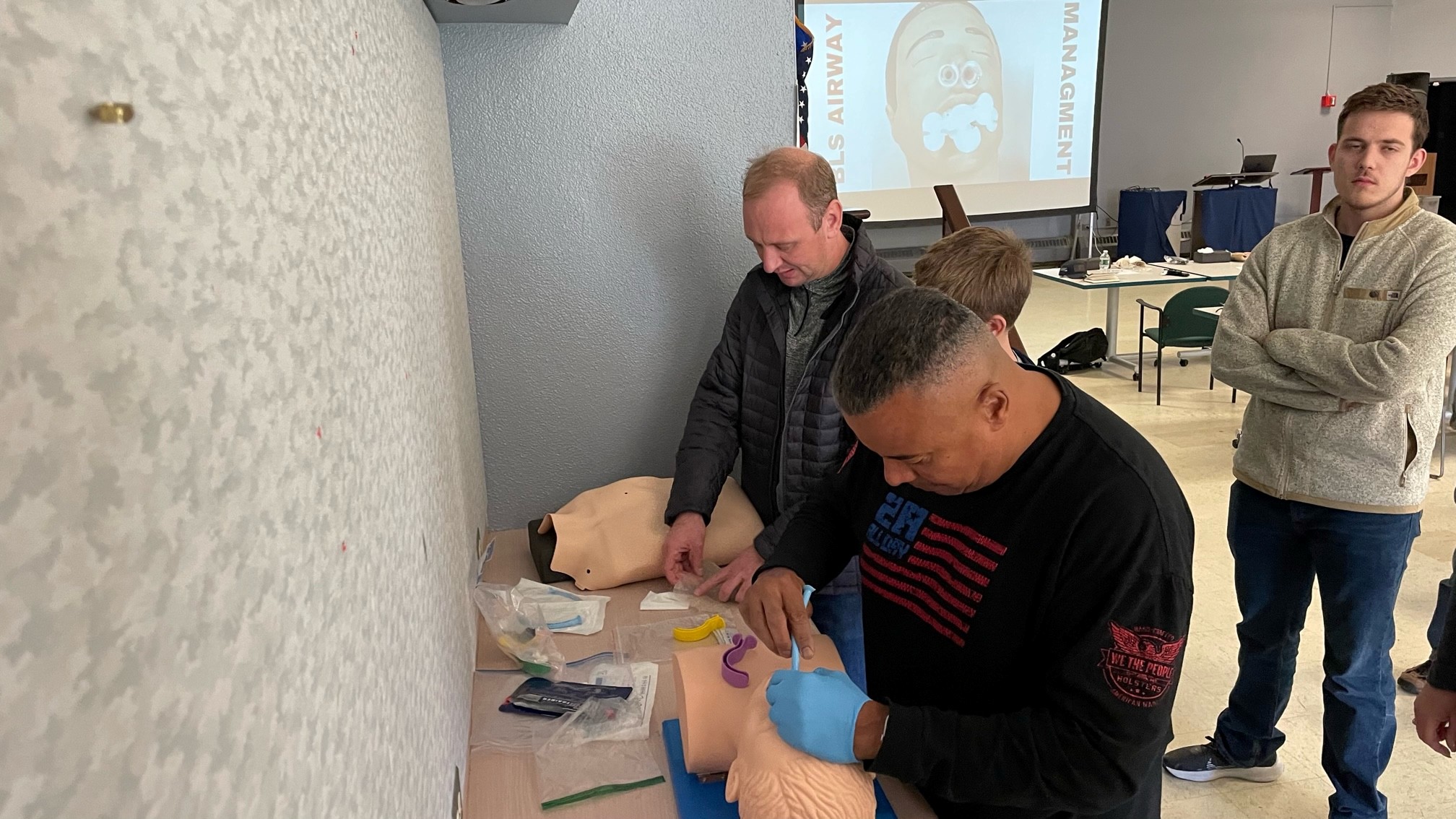
If you are involved in a violent encounter, the "math" continues after the shooting stops. How quickly can you apply a tourniquet? How fast can you transition to our Citizen First Responder protocols?
Following the MARCH mnemonic (Massive Hemorrhage, Airway, Respirations, Circulation, Head/Hypothermia) is just as critical as your draw speed. In the "First 30 Seconds" after a threat is neutralized, your focus must shift to preserving life.
The lessons from Ed Monk and the psychological insights from Deadly Force Encounters are not just academic, they are practical tools for the real world. At C&G Solutions, we are committed to providing the highest level of training for our community.
Whether you need to fulfill the state requirements or you want to push your skills to the next level, we have a path for you:
Safety is a shared responsibility. We believe the community is stronger when more people are trained and prepared. That’s why we offer a $50 "Bring a Friend" discount. When you register for a class, simply mention your friend’s name in the comment section during registration, and you’ll both benefit from the savings.
Defend with skill, Act with confidence.
If you found this breakdown of Ed Monk's The First 30 Seconds valuable, please share this post with your fellow carriers and friends. The more we understand the math of violence, the better prepared we are to stop it.
See you on the range (and in the classroom)!
*

Well-Taught, Well-Trained
Safety always comes first. We teach proper firearm handling to help prevent accidents and encourage responsible ownership.