




You’ve done the heavy lifting. You’ve successfully navigated through Massive Hemorrhage, secured the Airway, managed Respiration, and checked the Circulation. In the high-stress world of trauma care, it’s easy to think that once the "leaks" are plugged, your job as a Citizen First Responder is basically over. You’re waiting for the sirens, the patient is breathing, and the bleeding has stopped. You might even feel a sense of relief.
But there is a silent, often ignored killer lurking in the shadows of every trauma scenario: Hypothermia.
Most people think hypothermia is something that only happens to hikers lost in a blizzard or someone who falls through thin ice. In a trauma context, that line of thinking is not just wrong: it’s dangerous. At C&G Solutions, we teach our students that if you aren't actively fighting to keep your patient warm, you are losing the battle.
When we run drills at our facility in Mariners Cove (3615 Oceanside Road, Oceanside, NY), we often see students finish the "C" phase and then stand up, thinking they’re done. When asked about Hypothermia, the common excuses come out:
Here is the reality: Trauma-induced hypothermia has nothing to do with the weather.
Your body is a finely tuned machine that needs to stay at roughly 98.6°F to function. Your blood is the coolant and the heating system. When a patient loses blood, they aren't just losing fluid; they are losing their ability to regulate their internal temperature. They are starting from a massive heat deficit. If you wait until the patient is shivering to start warming them, you’ve waited too long. In fact, in severe trauma, the body may lose the ability to shiver entirely.
In medical circles, we talk about the "Lethal Triad" (also known as the Trauma Triad of Death). This is a vicious cycle that, once started, is incredibly difficult to reverse. It consists of three components:
Think about that for a second. You spent all that time applying a tourniquet or packing a wound to stop the bleeding. If the patient enters the Lethal Triad, their blood literally loses the ability to clot. They will bleed out from the smallest scratches, or worse, they will continue to bleed internally despite your best efforts. Hypothermia is the "on-switch" for this cycle.

Every drop of blood that leaves the body takes heat with it. Furthermore, when someone is in shock, their metabolism slows down, meaning they aren't producing new heat. When you combine this with the "conduction" of lying on cold pavement or "evaporation" from sweat or wet clothes, the body temperature can plummet in minutes: even on a summer day in New York.
As a Citizen First Responder, your goal is to preserve the heat the patient has left. You aren't just a medic; you are a human insulator.
Managing the "H" in MARCH doesn't require a medical degree, but it does require proactive thinking. Here is the protocol we teach at C&G Solutions.
During the "M" and "R" phases, you likely had to cut away clothing to find wounds or apply seals. That was necessary. Now, you need to cover those areas back up. Do not leave a patient exposed to the elements any longer than necessary.
Conduction is a major heat-sucker. Concrete, dirt, and even grass will pull heat directly out of a human body much faster than the air will. If it is safe to move the patient, get something between them and the ground. A coat, a rug, or even a piece of cardboard can save a life.
If the patient’s clothes are wet from rain, water, or blood, those clothes are now acting like a refrigerator. If possible, strip away wet layers and replace them with dry blankets or clothing.
Every IFAK (Individual First Aid Kit) should have an Emergency Heat Shield Blanket: often called a Mylar or "Space" blanket. These are lightweight, cheap, and incredibly effective at reflecting body heat back toward the patient.
When you use these, don't just drape them loosely like a picnic blanket. Wrap the patient like a burrito. Tuck the edges under them to trap the air. If you have access to a "Blizzard Blanket" or a more robust thermal wrap, use it.
 Visual: A properly stocked IFAK with simple tools that help you prevent heat loss fast.
Navigating a trauma scene can feel like an uphill battle. You are dealing with adrenaline, fear, and a ticking clock. It is easy to overlook the "invisible" problems like body temperature when there is "visible" trauma like a gunshot wound or a laceration.
However, your responsibility is to see the whole picture. Our courses aren't just about shooting or applying tourniquets; they are about building the confidence to act when things go wrong. Whether you are a concealed carry permit holder or just a concerned citizen, knowing how to prevent the Lethal Triad is just as crucial as knowing how to press the trigger to the rear.
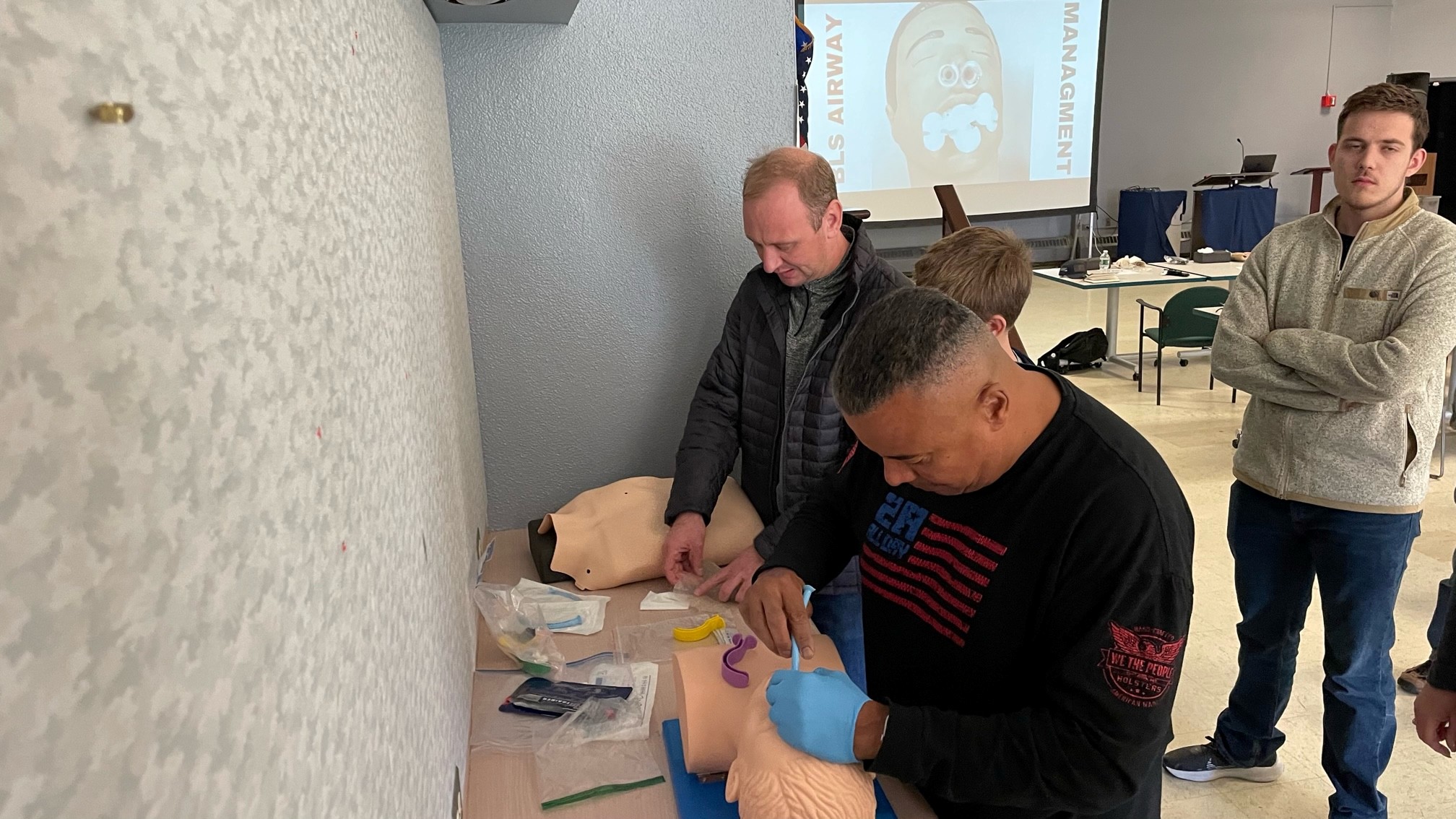
We focus on real-world application. In our classroom, we don't just talk about blankets; we practice the transitions from wound care to hypothermia prevention. We want these steps to be second nature so that when the stress is high, your judgment remains clear.
If you check your current first aid kit and you don’t see a dedicated way to manage hypothermia, your kit is incomplete. At a minimum, you should have:
Remember, the "H" can also stand for "Head to Toe." Once you’ve addressed the hypothermia, do a final sweep. Look for any injuries you might have missed during the initial chaos.
The MARCH algorithm is a roadmap designed to keep people alive in the worst moments of their lives. By following it: Massive Hemorrhage, Airway, Respiration, Circulation, and Hypothermia: you are using a system proven on the battlefield and in the streets by professionals worldwide.
At C&G Solutions, we are dedicated to providing customized training solutions that empower you to take charge. Safety isn't just a list of rules; it's a mindset and a set of skills that you carry with you every day.
Don't wait for a tragedy to realize you were missing a key piece of the puzzle. Join us for a Citizen First Responder course and learn how to bridge the gap between the incident and the arrival of professional help.
Defend with skill, Act with confidence.*
Found this guide helpful? Share it with your friends, family, or range buddies. The more people who know how to fight the "Lethal Triad," the safer our community becomes.

Well-Taught, Well-Trained
Safety always comes first. We teach proper firearm handling to help prevent accidents and encourage responsible ownership.